Close
About
What We Do
Support Us
Team
Newsletter
Events
Contact
Testimonies
Reports & Submissions
Get Support
Partnerships
#fixourfeeds
Quick Exit
ResourcesDonate
Menu

Newsletter

Get solicited advice, guest articles, fresh perspectives, and expert advice about all things sex, consent and relationships, straight to your inbox.

Sign Up to the Newsletter

Solicited Advice

Read Answer
Solicited Advice

"I find it really hard to tell my boyfriend what I like during sex. I want to say stuff like "a little shower" or guide his hand but I sort of just go along with what we usually do. I'm scared by bringing it up, it'll sound like I'm not enjoying it or criticizing him. I'm also a bit worried that if I ask to do new things it'll turn into pressure to do more than I'm comfortable with."

Click to flip
Solicited Advice

This is so common and so normal, which I want to say off the bat because I want you to know that nearly everyone who now can say what they like and want during sex at one point could have submitted the exact same question and they overcame their fears to do so, so you can too!

I’m a consent educator, intimacy coordinator for TV and film, and an artist. I mention that I’m an artist because what we’re mostly working with here is your creativity, believe it or not. We’re going to be getting into specificity which is a big part of consent, but it’s also a creative muscle, it’s the backbone of your artistic voice, and it’s going to show you who you are in the most beautiful, elegant, organic way. When we talk about asking for what you want, we’re talking about self-expression, and that really is a creative act in any medium, including sex.

I’m going to outline some ways to practice asking for what you want outside of sex, but the TLDR answer to your question is, for better or for worse, you’re going to have to push yourself to just…do it. There’s no real trick here, you have to just say something. Just say, “I like that” or “Try it this way” and demonstrate. It is going to feel weird and unnatural at first, but I can promise you that eventually, with practice, it becomes second nature. You don’t ever graduate from timid to confident simply because you’ve been having sex long enough; you actually have to practice. I think there can be this illusion that some people are good at it and some are not and so if you’re not doing it, then you must be in the second camp. This illusion suggests that some people find it easy and they were probably just born that way, lucky them! And sad, unfortunate you and only you find it challenging and so you need specialized attention and help learning how to do this thing. Not true! You can and you will learn. But there’s no way to skip the part where you push yourself through a little discomfort. And why do you push yourself through a little discomfort? Because we are learning, together, how to communicate. You will fumble and you will try again. But you have to throw a little spaghetti at the wall to see what works and what doesn’t, what feels authentic coming out of your mouth and what doesn’t. You need to try in order to collect data, and right now you have little to zero data.

Practice. Practice, practice, practice. No opportunity is too small. You like how your partner cooked your eggs this morning? Try, “I love how you cooked these eggs.” Be more specific. “I love the texture of these eggs. They’re so fluffy. I like how they’re gooey but not runny, and yet not dry at all.” Watch them light up. You like their outfit today? Try, “Your outfit is so cute. I love that pattern combo.” Add some flare. “Those jeans hugs your butt so perfectly” and give it a squeeze. Ooh lala! Practice giving constructive feedback. Trust that your intention shines through in your tone, in your face, in your eyes because you are you and only you! Your particular delivery, in your unique voice tells your partner about who you are, about what you notice, about what you want, and about how you see them. You’re not being critical, you’re giving a compliment. Saying “I love how you cooked these eggs” likely does not make your partner wonder if that means you’ve never liked any of the other eggs they’ve made for you. Instead it means they’ll probably bookmark the way they made them today so they can make them for you again in the future. See what I’m getting at?

You can also make suggestions. “Have you ever tried adding shallots to your eggs?” “Can I show you how I learned to make scrambled eggs?” “Here’s my favorite tool for folding an omelet.” No one’s being criticized, no one is panicking about what this means about all the eggs they’ve ever made up until now. We’re collaborating, we’re learning, we’re experimenting. What’s more, you’re sharing about yourself.

It feels important to point out that making requests (something for you, like, “I want to try ____”) can feel way more vulnerable than making offers (something for them, like, “Do you want me to _____?”) But let’s switch roles. Imagine your partner said, “I just found out about this position we haven’t done, do you want to try it?” If it sounded interesting, if you were curious, you’d probably go wide-eyed and say, “Yeah!” If it sounded uncomfortable or ouchie or bad to you, your face might scrunch up, you might shake your head and say, “Mmmmmm, I don’t know about that one.” And then what would happen? You’d move on and probably have perfectly good sex, as usual. Do you think your partner can handle that? I bet the answer is yes.

Consent and especially sexual consent have been boiled down to mean permission, a binary yes or no. But the origins of the word consent reveal what we’re really doing: con means “with” and sent means “feel.” We feel, together. We ask not, “Am I doing this right” and, “Am I doing a good job?” but rather, “Do we like this?” and, “How does this feel to us?” The second set of questions gets at something much more creative, and gives you a much more informative answer.

So how do you speak up? I’m afraid you already know the answer. You’re going to learn to speak up by speaking up. It feels weird now because you’ve never done it. It’s unfamiliar. It’s the same with your fear that making suggestions or requests might lead to situations where you feel pressured to do more than you’re comfortable with. But imagine yourself a few years down the line, with years of practice speaking up. Imagine how it would feel to say, “A little slower,” or, “Stay there,” or “Actually let’s stop,” or, “Nevermind, I don’t like that!” not for the first time, not for the third time, but for the hundredth time. There’s a version of you not so far away who is already a pro at this. The gap between you and them consists not of some catalyzing event or series of events that makes you suddenly “ready,” but rather of trial and error. As far as feedback and direction go, the worst case scenario is you give it a shot, it comes out sounding clunky and weird, you say to your partner, “That came out so much more awkward than it sounded in my head,” and you both get to laugh about it before trying again.

As for finding yourself in situations where you’re maybe in over your head, or not quite ready, or just realize you actually don’t want to do something but you already started, there are two most likely scenarios that I can envision (given that it seems clear you’re in a loving relationship with a caring partner). In one, you say something along the lines of, “Actually I don’t want to do this anymore” and your partner is so relieved you told them and they stop. In the second one, you transmutate what feels like pressure into something like curiosity. Sometimes I find myself feeling pressure from the outside and I realize that as a result, I haven’t even asked myself how I’m feeling in the moment. When I do, I think, “I’d like to see how this feels, or how it changes over time” until I find my limit and put a stop to it.

When done carefully and with a lot of awareness, this kind of exploration can help us learn what we like and don’t like, for future reference. Sometimes you have to hit, or even cross a limit or boundary to know where it is (I could write a whole piece on this kind of communication, with self and others, but in short, move slowly, remember you’re always allowed to change your mind, and even mistakes can provide incredibly useful information about you and your body. It can be helpful to say these things out loud before you begin: “I want to move slowly and I might change my mind mid-way through”). I promise you your partner wants you to tell them what makes you feel good. Most people just want to know they’re doing a good job and guidance and direction can actually help your partner feel more confident in their ability to make you feel good. Give them that gift!

‍

Read Answer
Read Answer
Solicited Advice

"I've been consciously trying to practice consent, but every time I do I feel like I'm being kinda awkward? I've talked about it with my friends and they say that explicitly discussing consent right before sex is super cringe. I'd just really like some tips around how to make it natural and casual."

Click to flip
Solicited Advice

First of all, thank you for being so real about this. I get what you're saying, and to be honest, I’ve felt this same tension and awkwardness in my own sexual encounters — overthinking every move, wanting to be respectful and sexy, but instead ending up in my head.

A lot of people want sex and consent to flow naturally, but human intimacy is far more complex. It’s emotional. It’s layered. It’s full of uncertainty. And yeah, sometimes it’s awkward.

I think part of that awkwardness comes from how consent has been framed as this non-negotiable necessity — which it absolutely is — but we’re often taught to think about it in a really black-and-white way: “No means no” and “Yes means yes.” While those are important foundations, they can give the impression that consent is a one-time verbal checkpoint. Like there’s a script: ask a question, get a response, proceed.

On top of that, many of us have grown up believing that “good sex” is supposed to be effortless and spontaneous, like in the movies where no one talks and everything just magically works. But in real life, people are full of contradictions. You can want something and still feel really nervous. You can be turned on and still need reassurance. You can be in the middle of things and suddenly realize that you’ve changed your mind. Real sex isn’t always smooth sailing. It’s full of weird sounds, uncomfortable pauses, miscommunications, and little moments of “wait, what’s happening?” Consent isn’t separate from that — it’s part of it, and full of nuance.

I don’t always know what I want when it comes to sex, and I have to figure it out as I go. There’s a lot of vulnerability in that, and that’s okay. A big part of practicing consent is being able to show up as your whole, present self in each moment (even if that self is unsure or anxious). It also means making space for your partner to do the same.

When two (or more) people are navigating their own boundaries, desires, and emotions all at once, of course it’s going to feel a little messy. But that doesn’t mean you’re doing sex or consent wrong.

One thing that helped shift my perspective was seeing consent less as a contract or a one-time permission slip, and more as a practice — something active, ongoing, imperfect, and deeply human. It’s a skill you build and grow over time — not just with your partner(s), but with yourself.
It’s not about checking a box — it’s about being present, curious, and communicative, even if that communication is a little weird at first.

So with all of this in mind, here’s the definition of consent I’ve landed on:

Consent is a practice that involves navigating your own desires, body, and boundaries, as well as navigating your partner’s — and communicating to figure out what feels good together.

The more we think of consent as a practice or a mindset, the less pressure there is to say the “right” thing. You don’t have to sit down on the edge of the bed and have a full debrief of your sexual history, boundaries, and preferences before anything happens — although you totally can if that feels good for you! Practicing consent doesn’t always look like a formal conversation. Sometimes it’s about entering the moment with the understanding that you and your partner bring different wants, needs, and boundaries to the table (or bed), and are open to discovering them together.

When that kind of mutual care and respect is the baseline, you can stay connected and communicate as you go. For example, if you're kissing and decide to put your hand on their thigh, you can ask, “Do you like it when I touch you like that?” or “Is this okay?” or “What do you want right now?” These check-ins can be playful, curious, and sexy. And now consent is part of the experience — not an interruption to it.

This is also where nonverbal communication becomes powerful. Our bodies communicate too. Eye contact, leaning in, guiding someone’s hand, pulling your partner closer, moaning, relaxing into touch — these are all ways we can express a yes without words. Just as importantly, there are cues that communicate a no, like freezing, pulling away, tensing up, or going silent.

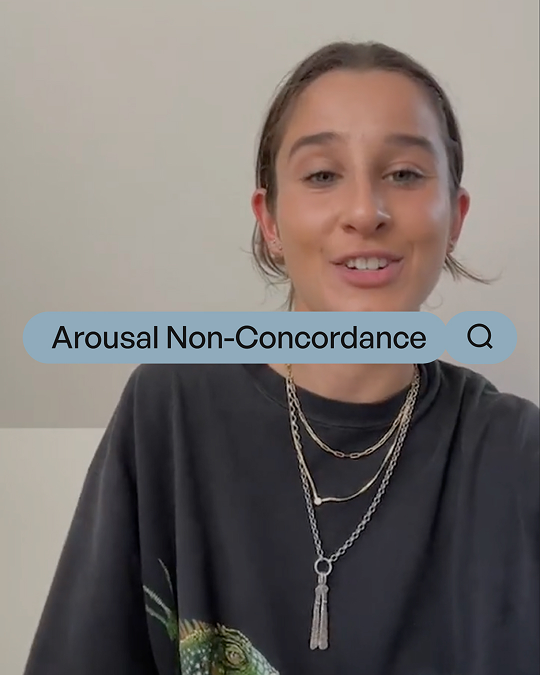
Paying attention to someone’s body language isn’t the same as assuming or guessing what someone wants based on how their body responds. That can lead to misunderstanding, especially when you factor in arousal non-concordance (when the body responds physically — like getting wet or hard — even if the mind isn’t on board). Instead, it’s about noticing the ways people express comfort, discomfort, pleasure, and desire. Does your partner seem present? Are they moving toward you or pulling away? Are they initiating or engaging in touch? These things don’t replace asking or checking in, but they do add to the fuller picture. Consent lives in that energy exchange.

It’s funny because I used to think I was “doing” consent wrong.

I thought if we didn’t pause for a formal yes/no conversation, I must be missing something. But when I think back, it’s not like we were skipping anything — we just didn’t realize we were already in a feedback loop. We were tuned into each other, reading the energy, asking things mid-moment, adjusting based on how it felt. That’s consent!

Still, mistakes can happen. Boundaries can get crossed, even when intentions are good. This is a huge missing piece in most consent education. A big part of practicing consent is being able to recognize when you’ve misread a signal or made a misstep, take accountability, and commit to doing better. It also means respecting if your partner sets a boundary in response to that. That’s the nuance I’m talking about. And I want to give a lot of credit here to consent educator Sarah Casper (@comprehensiveconsent), whose work helped shape how I now think and talk about consent.

Here are a few things that might help consent feel less awkward:

  • Reframe it: Consent isn’t a checkbox — it’s an ongoing conversation and a shared experience.
  • Stay present: Tune into your partner’s responses — not just their words, but their energy, body language, and tone.
  • Explore your own desires: Get to know what you like through solo pleasure so you can share it with more confidence and clarity.
  • Name the awkwardness: It’s totally okay to say, “Hey, I know this might sound a little awkward, but I want to make sure you’re feeling good.”
  • Check in afterwards: Talk about what felt good and what could be different next time.
  • Give yourself grace: You’re learning. Consent is a skill, not a performance.

I love that you’re having these conversations with your friends. That means you’re already on the right path and probably practicing consent in more ways than you even realize. You’ve got this!

Read Answer
Read Answer
Solicited Advice

"I've just heard the guy my friend is seeing be called a "rapist" by someone that knows him (detailing a specific incident that happened to a friend of theirs). I don't know what to do, and I don't know how I would manage it if I was my friend. How do I prioritize the victim's ownership of their story, making sure my friend is also safe? Do you end things without verification? Should forgiveness be possible?"

Click to flip
Solicited Advice

Thank you for asking such a thoughtful question with care and consideration, not only for your friend, but the survivor's stories and self-preservation, too.

This situation certainly warrants care and isn't a cut-and-dry answer. Your submission starts from a place of curiosity and honesty, in addition to admitting that you "don't know" how you'd navigate this if you were them. I want to focus on that statement and ask you to pause there. I think, based on your question, we're getting a revelation from your gut/intuition. You know something is off here. You're listening softly, and it sounds like you want to take action, but it also sounds like you feel you need to tread lightly.

I would invite you to lean back into that feeling of intuition and ask yourself, where do you get the most stuck on what to do? When you say you "don't know" what you'd do if you were them, what feelings arise? This is not only a way to help you process what you've heard, but also help you get clarity on how you feel about the situation and the many emotions involved. A feelings wheel may also be a helpful tool for you to further dissect your emotions.

From your submission, it's unclear how you came across this information (i.e., a night out, social media, etc.), but I also hear a fine line between wanting to preserve and validate the survivors' stories while also finding a way to find and communicate the truth. So let's parse out what comes next.

First, I hear you wanting to validate these stories, and I think we should honor them.

That value system lives within you. Trust it. Once you've taken time to reflect and get more clarity about your own feelings, it's time to consider how to approach your friend. This conversation deserves intentionality, not a casual mention between topics, but dedicated time and space where you both can process and have room to breathe.

You may feel pressure to have this conversation in person, and if you do, safety matters. This is a fragile situation that could elicit rage, disbelief, sadness, or a shutdown. Your friend deserves a space where she can feel all of this without being exposed or ambushed.

Consider a private setting, like your house, her apartment, or a quiet park. Somewhere she won't feel publicly exposed. Let her know ahead of time that you need to talk about something sensitive. Frame it honestly: "I'm not sure how to broach this, but I feel compelled to share something with you." While it may create some anxiety, it gives her mental space to prepare rather than being blindsided.

When you're ready to have the conversation, lead with compassion but be direct: "I heard something that's been weighing on me, and I care about you too much not to share it. Someone who knows [his name] told me about a specific incident where he sexually assaulted their friend. This is the second time I've heard something like this about [his name]. I need you to know because I want you to be safe and have all the information to make your own decisions. I take these statements seriously, and I would want to know if I were you."

There may be awkwardness or a long pause. Lean into it. This conversation requires space. Be prepared for the wide array of emotions. Your friend may immediately deny it, react in anger, question you, shut down, or say she needs time to process and can't talk further. All of these are normal and valid. Your job isn't to convince her of anything; it's to deliver the information you believe she deserves to know and hold space for whatever comes next.

On Verification and Belief

You asked whether you should "end things without verification," and I want to address this head-on because it's at the heart of your question. The answer is that this isn't your relationship to end, and verification is more complicated than you might think in these cases.

First, understand that in personal relationships, we're not operating in a court of law. You don't need "proof beyond a reasonable doubt" to take information seriously or to be concerned for your friend's safety. When someone shares that they or someone they know was assaulted (especially with specific details) that deserves to be believed and taken seriously.

Second, what would verification even look like here? A police report? A conviction? The vast majority of sexual assaults are never reported, and even fewer result in prosecution.

Yes, you're hearing this secondhand, which adds complexity. But you now know that two separate people in two separate situations this year have identified a man your friend is dating as having committed sexual assault. That's a pattern. That's information. Your body already told you it’s something you personally can’t ignore.

Your responsibility isn't to investigate or determine guilt. It's to share what you've heard so your friend can make informed decisions about her own safety. She gets to decide what she does with that information, including whether she believes it, whether she stays, whether she investigates further herself.

On Forgiveness and Accountability

You also asked whether forgiveness should be possible. Let's be clear about whose forgiveness we're talking about.

The survivors get to decide whether they forgive their assailant. That's their story, their healing journey, their choice. No one else gets to make that determination or pressure them toward forgiveness as some kind of moral ideal.

Your friend is in a different position. She wasn't the one harmed (that we know of), so it's not her forgiveness to grant. What she can decide is whether she wants to be in a relationship with someone who has harmed others, whether she believes accountability has happened, and what her own boundaries and values tell her to do. It’s also not your friend’s job to rehabilitate someone who has caused harm.

The harder truth is that patterns of sexual violence tend to continue. This person has been named by two different people in two different contexts this year alone. Your friend deserves to know that staying with someone like this means accepting significant risk to her own safety, even if she has evidence to the contrary.

Supporting Your Friend Through Her Process

After you've shared what you know, your friend gets to make her own choices, even if you disagree with them. She might stay with him. She might need time to process before deciding. She might end things immediately. She might even need space from you for a while. Whatever she chooses, your job is to remain a safe, non-judgmental person in her life.

That doesn't mean you can't have boundaries. You can say, "I support you, and I'm here for you, and I trust your decision.” If you need to create distance to stay aligned with your morals, you could add, “I also can't be around him or pretend everything is fine if you choose to stay with him." You can express concern while respecting her autonomy.

If it feels right, keep checking in. Not with judgment, but with curiosity about how she's feeling and whether she feels safe. Watch for signs of escalation or harm. Make sure she knows you're there whenever she needs you, whether that's tomorrow or six months from now when she's ready to leave.

Resources and Safety Planning

Encourage your friend to trust her gut. If something feels off, it probably is. If she's noticing controlling behavior, boundary violations, or anything that makes her uncomfortable, those are warning signs worth paying attention to. Have resources ready for local sexual assault advocacy organizations and domestic violence resources if things escalate. You don't need to push these on her immediately, but knowing they exist and being able to offer them when she's ready can be invaluable, and give you a sense of purpose and action.

Trust Yourself

You started this submission by saying you didn't know what to do. But I think you do know. You asked how to prioritize the survivors' stories while keeping your friend safe, and the answer is that you do both by telling her the truth. You honor the survivors by believing their experiences and taking it seriously enough to act on it. You honor your friend by trusting her with information she deserves to have about someone she's intimate with.

Thank you for caring enough about both your friend and these survivors to ask this question. That care is exactly what will guide you through this conversation.

‍

Read Answer
Read Answer
Solicited Advice

"A close friend of mine (mid-20s) has been in an on-and-off relationship with a man (mid-50s) she met while living overseas. She spent all her time with him, and was isolated from her support systems, but when she moved home she cut contact and we thought it was over. Recently they reconnected, and now he wants her to move back overseas to be with him. What worries me is that when they’re apart, she talks a lot about wanting children and a future family, but when they’re together she suddenly says she doesn’t want that anymore. I’ve raised my concerns, as have her parents, and I don't know whether to accept it, leave it, or how to be the best support for her."

‍

Click to flip
Solicited Advice

Thank you for showing a level of care that all of us would be lucky to have in our friendships.

You finished your question with "I want to be a support for her" but it's clear you are already on that journey. It's understandable that you're asking questions. She is an adult, but thirty years is a very large age gap, situating your friend and her boyfriend in very different stages of their life, emotional maturity and experience of relationships. Friendship means looking out for your friend in any relationship and this one is no different.

I'm going to start by holding your hand and saying something tricky: your friend's relationship is hers and she is going to make her own decisions. That is the ultimate truth. However, that doesn't mean you can't do exactly what you've said: be a support. The question becomes "what kind of support?" Given the concerns you've outlined in your question: the secrecy in the beginning, him leading her on, her becoming isolated from her support systems, her parents' concern and her flip-flopping her wants for the future depending on who she's with, thinking about exactly what kind of support feels especially important here.

In our culture, age-gap relationships are common, especially in heterosexual relationships where the woman is younger than the man. This normalizes them and makes it challenging for us to critically analyze without feeling like we are being judgmental. We should practice this regardless, as it helps us all develop critical thinking skills about power and what is healthy to look for in our relationships because, remember, things can feel good even if they're not healthy.
I want to jump to the main question you asked: should you be worried about power dynamics?

Great question, let's explore it. Power is at play in every single relationship we have in varying ways: romantic, familial, friendships, at work, etc. People hold different levels of power depending on their gender, age, race, ability, the role they play, the amount of money they have, their social status, and more. The power we hold is influenced by the society we're in, the identity we have, how our life is structured, our view of ourselves and the values we hold, to name a few. Recognizing what types of power we hold, the impact of it on others, and how we use it is everything.

Age is an obvious power dynamic playing out in your friend's situation. Her boyfriend is thirty-ish years older so it's safe to assume he'll have developed a level of life experience over the three decades he lived as an adult before meeting her. Maybe he is independent in how he lives: his habits and routines may be more set, his foundations like location and family may already be established and immovable. Maybe he's accrued professional experience and developed himself in different careers or jobs. Maybe he's held positions of power at work. All of these can feed into a sense of self, confidence, and competence that looks different from hers, given she hasn't yet had those three decades of experience.

Gender is also a factor here as men hold more power advantage than women in society. They are socialized into seeing themselves – and being seen – as the dominant partners in a heterosexual relationship; the provider, decision maker, leader, and protector. An age gap can also exacerbate this and certain gendered dynamics can become expected.

Finally, though there weren't details about this in your question, given this man is in his mid-50s, we can assume he has a level of financial independence and accrued finances that she doesn't yet. Not only did he grow up in an entirely different economy but he has had three decades more to accrue money and assets. We live under capitalism where everything is dependent on money, so with that in mind, he may have access to a level of power via his money that she doesn't have. I also want to note here that right now "princess treatment" and leaning into traditional gender roles such as relying on a man's finances are being served as empowering trends on TikTok. Regardless of how good it might feel, relying on someone else's finances in a relationship has material consequences. It can lead to feelings of obligation, create or exacerbate power dynamics, or encourage an inability to exit a relationship (especially if someone is cut off from support systems). I note this because current discourse could be shaping your friend's perception of these types of financial power dynamics.

These are all things to consider and then observe in the way your friend speaks about her relationship with him. My advice would be to gently ask questions over time that allow you, and her, to question whether these dynamics are playing into their relationship or not.

The more I read over your question, and focus on the details within it, the more I wonder whether you asking if you should be concerned or not could, in itself, be a sign that there is something to be concerned about.

The tricky part here though is that if she is entering into, or already in, a relationship with unequal power dynamics and the abuse of them (which is sometimes hard for those to identify from the inside, let alone from the outside!), trying to make her "see sense" or control the outcome is likely to actually push her further into the relationship, especially if you've already noticed her become isolated from her friends and family once. We don't want this for any woman in a fairly new relationship, but definitely not if we're already concerned and she might be moving away!

In your letter you gave yourself two options: "accept" or "leave it." But I think you have a secret third option: become the friend she'll need whether she stays or goes. Become a witness. My instinct is that the best thing you can do for her is to keep communication vulnerable and open so that whatever happens you're more likely to know about it and be able to support.

Now, this is easier said than done. It requires patience, compassion, and you finding places to process your feelings about the situation away from her. It's one of the trickier forms of support because we end up having to be a little strategic with our honest feelings. It's probably going to look like saying "how are things going with [name]? How are you feeling about the future?" when all you want to say is "I am concerned and don't think this is right!" You will have to take care of yourself to stay regulated enough to show up for her like this too, so have a think about how you might need support during the process: journaling? Maybe a close friend to debrief with?

If you can keep in good contact with her – wherever she is – and develop an ongoing non-judgmental space for her feelings, experiences, and any observations of her relationship, she's going to be more likely to be able to identify issues when and if they arise. Creating a container where she wants to talk through decisions but with the considered lens of someone who knows her well and wants what's best for her is the kind of support that will help her make the healthiest decisions for herself, and ultimately that's what we want, right? You know her best. Think about what might work best and what might allow her to open up to you more.

Sometimes friendship looks like thinking ahead and doing what's best for our loved one, even if it's trickier for us. But that's part of loving someone; being there even when it frustrates you.

Good luck and take care of yourself in the process, too.

Read Answer
View More

Get Solicited Advice

Confused about consent? Having an ‘Am I The Asshole?’ moment? Need guidance on talking to young people in your life about consent? Just ask us.

Each fortnight, our expert columnists give one anonymous question their best advice.

Thank you! Your submission has been received!
Oops! Something went wrong while submitting the form.

Deep Dives

19.5.25

Why A Specific Type Of Sexism Attracts Women

Ben thinks women are wonderful. He thinks they are, on average, more cultured and ethical than their male counterparts. And he believes the best thing a man can do for himself is find a woman to love and treat her right. Ben never lets his girlfriend touch a door handle, and at the end of dates he almost always pays the bill. Whenever the couple faces a hassle—navigating the airport, sorting out taxes—Ben takes the lead.

Read Article
19.5.25

Are "Masculine" and "Feminine" Energies Just Patriarchy Repackaged?

“If you want to attract a masculine man while you’re dating,” explains a dating coach on TikTok to the women in her audience, “do not lead with your accomplishments. If you’re leading with your accomplishments, anything that’s based on performance or doing or hard work, you’re actually leading with masculine energy.”

Read Article
20.10.25

“Patriarchy is bondage for boys, too. It disfigures them. Even if they’re the last to notice. Even if they profit from it.”

How do you teach a 16-year-old boy that the same system that boys and men are profiting from, that gives them power, is also robbing them? How do you engage boys and young men in that conversation? 

Read Article
20.2.26

Algorithms Are Fueling Misogyny, Which Fuels Sexual Violence.

Even though most young men are not looking for anti-feminist content, the invisible code behind our screen seems hellbent on making sure it finds them. We can’t sit by while invisible algorithms stir up hateful views and promote violence on and off our screens.

Read Article
20.2.26

The Rigid "Rules" Hurting Young Boys

Teenage boys who strongly support restrictive ideas about “being a man” are more likely to cause harm to themselves and others. We dive into the 'Adolescent Man Box' study from Jesuit Social Services.

Read Article

20.2.26

What Happens When Your Boyfriend Is Red-Pilled?

Red-pill rhetoric harms everyone, from women like Claudia who face abuse, to the men who adopt these views. Culturally, we must reckon with the systems amplifying this content and regulate social media algorithms.

Read Article
Black Asterik

Join our newsletter. Smart, nuanced sex & relationships advice.

Click to search...
LTrust ink 1T

Please see our privacy  statement and terms of use for more information

Thanks, we'll be in touch
Oops! Something went wrong while submitting the form.
Contributors

Writers & advice-givers

Macken Murphy
Read Bio
Macken Murphy
Tara Michaela Jones
Read Bio
Tara Michaela Jones
Emily Depasse
Read Bio
Emily Depasse
Mariah Caudillo
Read Bio
Mariah Caudillo
Gemma Katsalidis
Read Bio
Gemma Katsalidis
Sarah Casper
Read Bio
Sarah Casper
Professor Neil Shyminsky
Read Bio
Professor Neil Shyminsky
Dr.  Joy Townsend
Read Bio
Dr. Joy Townsend
Mia Schachter
Read Bio
Mia Schachter
Gina Martin
Read Bio
Gina Martin

@teachusconsent

Mia Schachter
Mia Schachter
Close

Hi, I'm Mia. I'm an author, multi-media artist, and an intimacy coordinator for TV, film, and theater. It’s my mission to make consent education as digestible and widely available as possible so you can identify your desires, needs, and boundaries and authentically express them to others in your own unique voice. Relationships are my life’s work.

Socials
Linkedin
Facebook
Dr.  Joy Townsend
Dr. Joy Townsend
Close

Dr. Townsend is the Founder and CEO of Learning Consent, a leading provider of comprehensive relationships and sexuality education.

Socials
Linkedin
Facebook
Thomas Cotter
Thomas Cotter
Close
Socials
Linkedin
Facebook
Ashton Bush
Ashton Bush
Close
Socials
Linkedin
Facebook
Gina Martin
Gina Martin
Close

Gina Martin (she/her) is a multi-award winning gender equality activist, facilitator, writer and speaker known for her work fighting gender stereotypes, misogyny, sexual violence and the manosphere. She is most well known for making upskirting illegal in England & Wales – which led to three countries following suit – and changing global discriminatory Instagram policy. She works in schools across Australia facilitating young people of all genders on the impact of gender stereotypes.

Socials
Linkedin
Facebook
Enoch Mailangi
Enoch Mailangi
Close

A recent MFA graduate of the National Institute of Dramatic Arts, Enoch was a 2019–2021 Sydney Theatre Company Emerging Playwright and is currently a Resident Artist with Urban Theatre Projects. They created and wrote the AACTA Award-winning comedy series All My Friends are Racist for ABC iview, which premiered internationally at Series Mania in France.

Enoch has written across a number of series, with a strong focus on teen and children’s audiences, including Stan Original’s Year Of, SBS’s While The Men Are Away, ABC Kids’ Crazy Fun Park and the upcoming Stan Original series Invisible Boys.

They were also a consultant on Heartbreak High Season 2 and a recipient of Screen Australia’s Talent: New York program. Enoch’s screenwriting work extends to collaborations with visual artists, most recently contributing to Joel Sherwood Spring’s SETTLED for the Macfarlane Commission at ACCA in Melbourne. Their work has been recognised by Vogue Australia and IF Magazine as one to watch.

Enoch is passionate about developing new Australian works that champion Queer, Indigenous, and Pasifika voices.

Socials
Linkedin
Facebook
Zenae Powell
Zenae Powell
Close
Socials
Linkedin
Facebook
Chloe Korbel
Chloe Korbel
Close
Socials
Linkedin
Facebook
Professor Neil Shyminsky
Close

Neil is from Sudbury, Canada, and has been an English Professor at Cambrian College since 2014. He has a bachelor’s degree from York University and a master’s degree from the University of Toronto in English Literature. He achieved PhD Candidacy in Social and Political Thought at York.

Neil has published numerous articles in academic journals and books including the International Journal of Comic Art and Men and Masculinities. He’s co-edited a textbook on the study of popular culture and is currently writing a book about the practice of healthy masculinity.

He is also a prolific creator of short-form content on social media, having published more than 3000 videos since 2021. He has produced videos for a large and diverse range of companies and non-profits, such as Penguin Random-House, Ergobaby, Glassdoor, Sierra Club, Defeat Duchenne, and Teach Us Consent. As a content creator, he was recently a finalist for a 2025 Cheer Choice Award in the category of Education.

Recently, Neil has branched out into public speaking engagements, recently leading discussions and delivering lectures at the University of Waterloo, Arizona State University, McMaster University, and Georgian College.

Socials
Linkedin
Facebook
Tara Michaela Jones
Tara Michaela Jones
Close

Tara Michaela is a Black, queer sex educator based in Philadelphia and New York, USA. She is the founder of The Youth Sexpert Program, a non-profit training program that aims to provide comprehensive sex education for high school aged youth, so they can become their community's sex expert.

Her work focuses primarily on how injustice manifests in sexual interactions. She uses her social media platforms and written pieces to connect with her community on these issues.

Socials
Linkedin
Facebook
Gemma Katsalidis
Gemma Katsalidis
Close

Gemma is a policy specialist from Melbourne, now based in New York City. She holds a Master of Public Policy and Management and a Bachelor’s Degree with Honours in Political Science and Media. With a background rooted in women’s health and cultural policy, Gemma has a strong commitment to gender equity and social reform, and is passionate about driving systemic change through education, advocacy and inclusive policy design.

Socials
Linkedin
Facebook
Emily Depasse
Emily Depasse
Close

Emily L. Depasse is a vivacious sex and relationship educator captivating audiences with her vibrant digital content, where sexual health shines as the ultimate act of self-care. She earned her MSW and MEd in Human Sexuality from Widener University's dual degree sex therapy program at the Center for Human Sexuality Studies. She also holds a BA in Gender and Sexuality Studies with minors in English and psychology from Salisbury University. Her expertise has garnered recognition from numerous publications, including Cosmopolitan, Today, The Seattle Times, and more.

Socials
Linkedin
Facebook
Mariah Caudillo
Mariah Caudillo
Close

Mariah (she/her) is a Queer and Latine sex educator and digital learning designer dedicated to creating inclusive, shame-free, and culturally responsive sex education. As the creator of Sex Ed Files, she uses social media to answer anonymous questions and make complex topics more accessible.

Mariah shows up with curiosity, care, and a commitment to justice, drawing from her lived experiences as a sexual assault survivor, ex-evangelical, and eldest child in a multiethnic household. Guided by QTBIPOC wisdom and rooted in community, her work centers connection, joy, and the belief that everyone deserves sexual health knowledge.

‍

Socials
Linkedin
Facebook
Macken Murphy
Macken Murphy
Close

Macken Murphy is a 27-year-old scientist who has a Master of Science degree in cognitive and evolutionary anthropology at the University of Oxford, as well as being a respected content creator, accomplished amateur boxer, published writer, and host of his podcast: Species.

Before finding TikTok fame, Macken was the host of Species, which was one of the most popular science podcasts in the world and recommended by the BBC and New York Times.

Since then, Macken is also the host of the Listenable audio course on Human Evolution, which has ranked as one of Listenable’s most popular courses. Macken has also served in the Americorps where he helped teach science at an underserved middle school.

Socials
Linkedin
Facebook
Sarah Casper
Sarah Casper
Close

Sarah is a Consent Educator at Comprehensive Consent. Through her workshops, curricula, and social media platforms, she has helped thousands of kids, adolescents, and adults deeply understand consent, improve their relationships, and become more prepared for the complexities of safe and ethical physical intimacy. Using social-emotional learning theory and practices, Sarah equips kids, teens, and emerging adults with the knowledge and skills necessary to navigate body boundaries and create healthy relationships. Sarah is the author of The Kids & Consent Curriculum

Socials
Linkedin
Facebook
asterik
About
What We Do
Team
Newsletter
Reports & Submissions
Contact
Donate
Learn
Resources
Testimonies
Get Support
Social
Instagram
Facebook
LinkedIn
Tiktok
Legal
Terms
Privacy
Accessibility Statement
Policies
AUS
AUS
©2025 Teach us consent
All rights reserved
built by not another™