The Rigid "Rules" Hurting Young Boys

.png)
Read in...
“Always appear confident, even if you aren’t”
“Don’t do anything that could be perceived as girly or gay”
“Talking about your feelings is weird”
“In hetero relationships, men should be the main provider for their families”
You probably recognise these classic examples of gender norms commonly ascribed to young boys — rules that, when followed, should make someone the “ideal man.”
These rules are the subject of a new Australian study from Jesuit Social Services, The Adolescent Man Box, which surveyed 1400 young people about their endorsement of rigid ideas of masculinity.
They’re the subject of our newsletter today, too, because a strong association emerged in almost every data point in the report (and there were dozens): teenage boys who strongly support restrictive ideas about “being a man” are more likely to cause harm to themselves and others.
Firstly, the researchers explored how much perceived social pressure there is on boys to act in these ways. Then, they looked at whether boys personally endorse these ideas, separating them into five quintiles ranging from least to most supportive. From there, they mapped levels of endorsement against different behaviours and outcomes, including aggressive behaviour, victimisation, pornography habits, image-based abuse, mental health, and bullying.
So, what pressures are young boys facing?
Before we get into how many boys actually endorse these rules, it’s important to note that while most boys don’t personally agree with them, the majority still feel pressured to act that way. Around 60% of all young people believe society expects teenage boys to be manly, confident, and strong at all times, a perception shared equally by girls and boys.
That’s the problem we can collectively fix. If we want boys to live healthier, happier lives and treat women with respect, we need to stop normalising and reinforcing the subtle pressures that keep these ideas alive.
If boys do personally endorse these ideas, what are their attitudes towards women?
Most relevant to our mission of eradicating normalised sexual violence is one of the study’s key findings: a significant number of boys who most strongly endorse traditional masculinity (we’ll call them ‘endorsers’) hold attitudes that support violence against women:
- 27% of endorsers agreed that if a man is violent towards his partner, it’s probably because she deserved it or provoked it. This is compared to just 2% of boys who most strongly reject The Adolescent Man Box rules.
- 20% of endorsers agreed that sharing nudes of your partner after a breakup is not a big deal. This is compared to 0% of boys who least support the rules. This points to a fundamental devaluing of women’s body autonomy and right to digital consent, alongside beliefs in male ownership and the “right to retaliate” after rejection. These are concerning attitudes that underpin many forms of intimate partner violence.
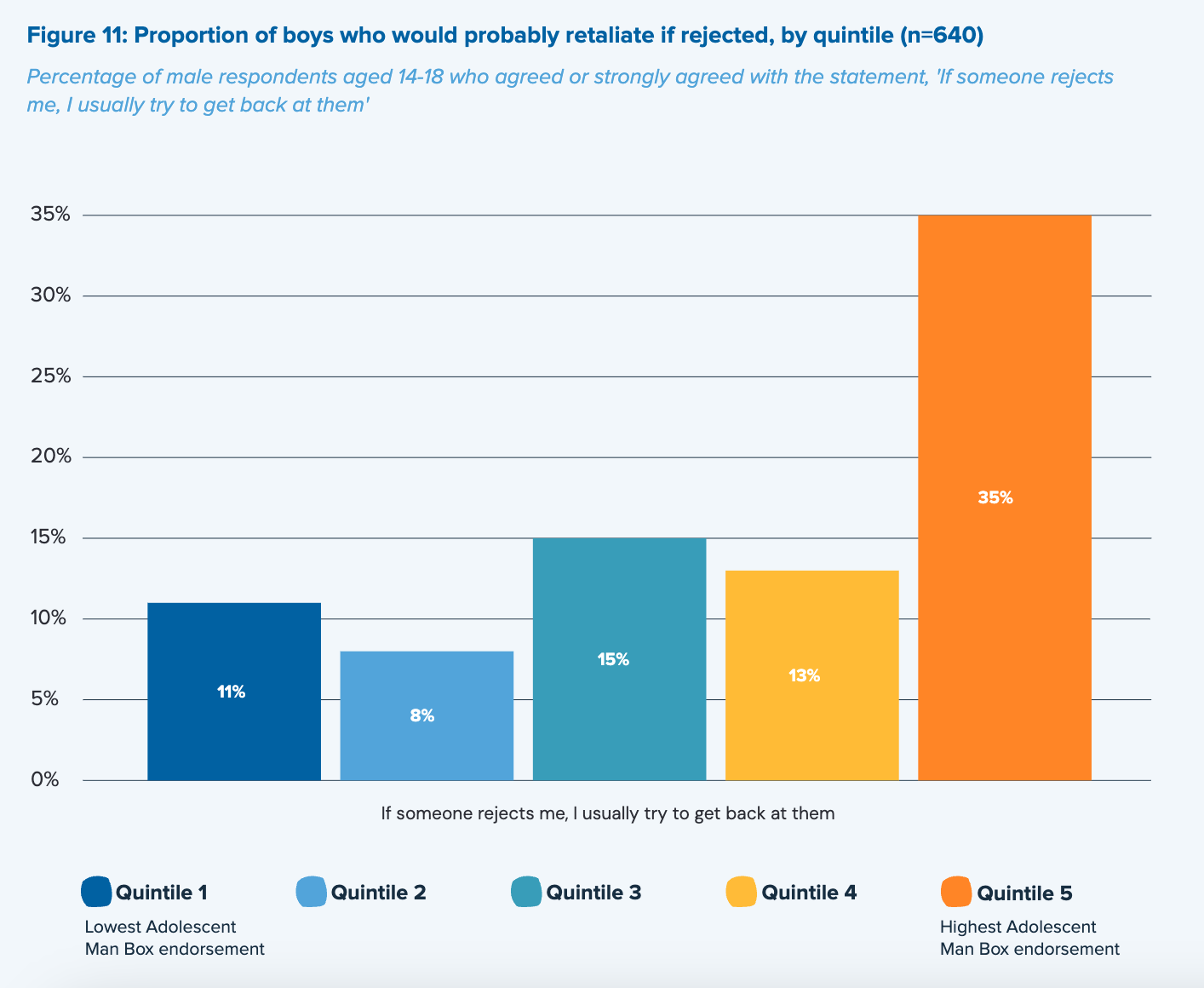
- 27% of endorsers say their friends would use AI to create fake nude images of people they know. This is compared to 4% of boys who least support the rules.
- 52% of endorsers believe it’s okay to call or text their partner multiple times when they don’t respond immediately, and 42% believe that it’s normal to continually check who their partner is communicating with. These figures are far higher than boys at the other end of the scale.
- In terms of gender relations, 67% of boys who most strongly endorse The Adolescent Man Box rules agree that boys have it harder than girls. This is compared with 11% of boys in the least supporting quintile.
While the source of this belief can only be speculated, it could spring from adolescent boys’ own experiences of being confined by loyalty to rigid masculine norms that stifle their mental health and isolate them from support. It might also be influenced by an idea aggressively promoted online; that “women are the source of your problems”. This narrative is commonly spread by the very same figureheads who profit from promoting adherence to these restrictive gender norms and, in turn, from adolescent men’s distress.
It’s clear that harmful ideas about manhood aren’t just abstract or archaic beliefs of the past. Boys are still being taught to equate masculinity with dominance, detachment, and control, and it’s normalising disrespect and violence.
When it comes to the impacts this has on the mental health and wellbeing of young boys, the findings are just as troubling.
Boys with the highest endorsement of The Adolescent Man Box were far less likely to agree they could be vulnerable with a friend (65% compared to 89%), and twice as likely to say that no one really knows them well (46% compared to 23%). While poor mental health was concerningly present in all young people — and notably, more prevalent in girls — boys who strongly endorsed the rules were more likely to report symptoms such as having little interest or pleasure in doing things, feeling down, depressed or hopeless, or having thoughts of self harm.
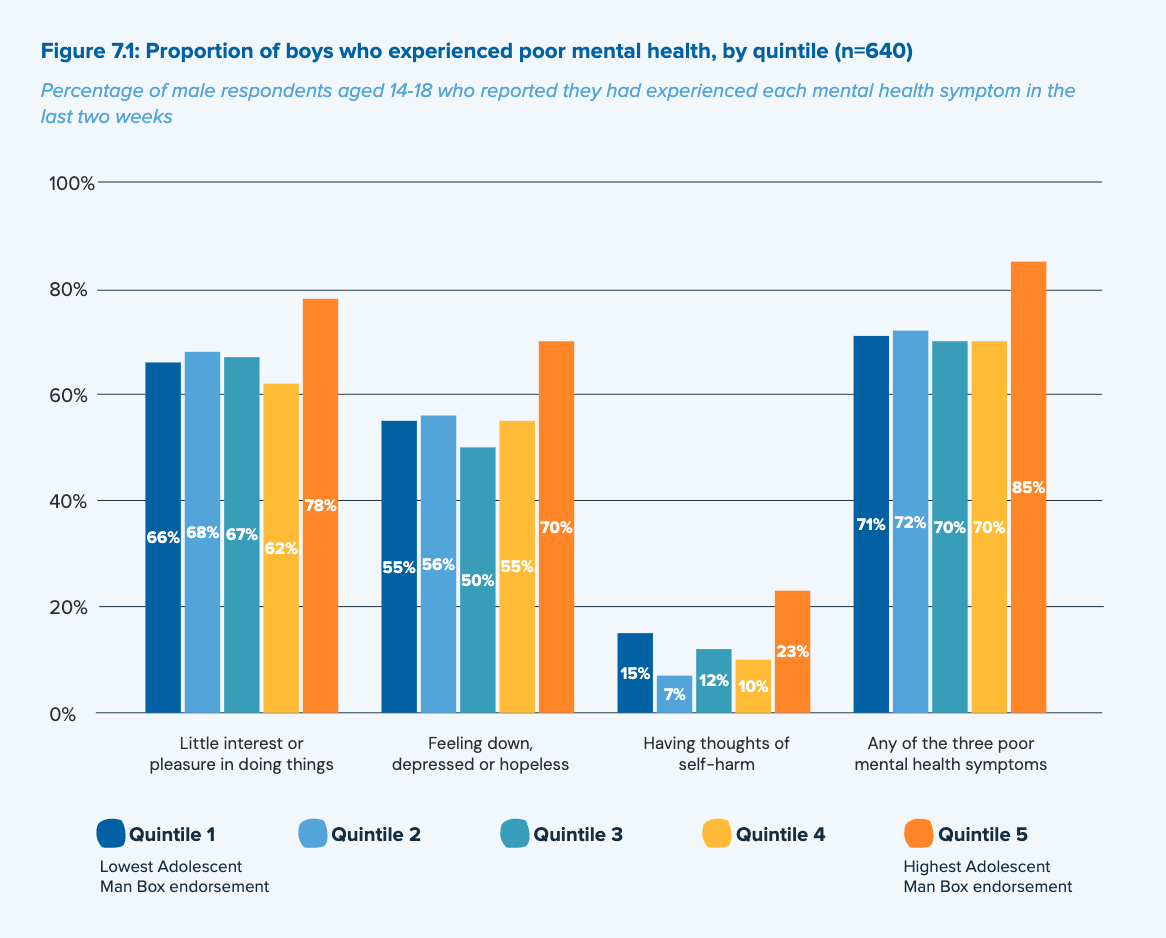
These statistics paint a bleak but deeply human picture: millions of adolescent boys simply following the “rules” they think they’re supposed to, and being rewarded with feelings of loneliness, disconnection, depression and hopelessness.
We’ve posted about this on social media this week and, unsurprisingly, received many comments akin to “in other news, water is wet.” While the link may seem obvious to some, it’s far less obvious to others. Many people believe that conforming to these ideals protects them from violence, makes them better partners, and helps them succeed in a patriarchal world — where they’ll naturally be rewarded with wellbeing, community, and strong relationships. That the opposite is true will come as a shock to some, and these are the people we must support through that realisation.
We’ve been taught to believe that masculinity is just “who you are” if you’re born male, rather than something constructed, performed, and reinforced by culture. But if something is constructed, it can be reconstructed, and that’s where the prevention begins.
What’s next?
The report delivered clear and actionable recommendations that align closely with the work Teach Us Consent does every day.
It calls for:
- Increased accountability and strengthened regulation for tech platforms, including algorithmic recommender systems.
- More support for parents and carers to talk with their boys about sensitive issues like consent, pornography and masculinity.
- The strengthening of violence prevention efforts across schools and communities, ensuring topics such as harmful pornography use, image-based abuse, digital surveillance and transphobia are addressed.
At Teach Us Consent, we see these findings as powerful calls to action. Preventing sexual violence includes writing new stories about what it means to be a man. As a society, we need to teach and wholeheartedly support new versions of masculinity, that recognise the multiplicity of individuals and centre empathy, emotional expression, connection, and respect.
Amid all the concerning statistics, there’s hope. Almost all boys surveyed said they are disturbed by the harassment of women and girls. 84% said they feel mostly positive about their futures. And most said their parents had more influence on their ideas about how to act than media or influencers.
This tells us that the next generation wants to do better, but they can’t dissolve these pressures alone. It’s on all of us to model what healthy masculinity looks like, challenge harmful norms, and make empathy, respect and consent the standard.
“Always appear confident, even if you aren’t”
“Don’t do anything that could be perceived as girly or gay”
“Talking about your feelings is weird”
“In hetero relationships, men should be the main provider for their families”
You probably recognise these classic examples of gender norms commonly ascribed to young boys — rules that, when followed, should make someone the “ideal man.”
These rules are the subject of a new Australian study from Jesuit Social Services, The Adolescent Man Box, which surveyed 1400 young people about their endorsement of rigid ideas of masculinity.
They’re the subject of our newsletter today, too, because a strong association emerged in almost every data point in the report (and there were dozens): teenage boys who strongly support restrictive ideas about “being a man” are more likely to cause harm to themselves and others.
Firstly, the researchers explored how much perceived social pressure there is on boys to act in these ways. Then, they looked at whether boys personally endorse these ideas, separating them into five quintiles ranging from least to most supportive. From there, they mapped levels of endorsement against different behaviours and outcomes, including aggressive behaviour, victimisation, pornography habits, image-based abuse, mental health, and bullying.
So, what pressures are young boys facing?
Before we get into how many boys actually endorse these rules, it’s important to note that while most boys don’t personally agree with them, the majority still feel pressured to act that way. Around 60% of all young people believe society expects teenage boys to be manly, confident, and strong at all times, a perception shared equally by girls and boys.
That’s the problem we can collectively fix. If we want boys to live healthier, happier lives and treat women with respect, we need to stop normalising and reinforcing the subtle pressures that keep these ideas alive.
If boys do personally endorse these ideas, what are their attitudes towards women?
Most relevant to our mission of eradicating normalised sexual violence is one of the study’s key findings: a significant number of boys who most strongly endorse traditional masculinity (we’ll call them ‘endorsers’) hold attitudes that support violence against women:
- 27% of endorsers agreed that if a man is violent towards his partner, it’s probably because she deserved it or provoked it. This is compared to just 2% of boys who most strongly reject The Adolescent Man Box rules.
- 20% of endorsers agreed that sharing nudes of your partner after a breakup is not a big deal. This is compared to 0% of boys who least support the rules. This points to a fundamental devaluing of women’s body autonomy and right to digital consent, alongside beliefs in male ownership and the “right to retaliate” after rejection. These are concerning attitudes that underpin many forms of intimate partner violence.
- 27% of endorsers say their friends would use AI to create fake nude images of people they know. This is compared to 4% of boys who least support the rules.
- 52% of endorsers believe it’s okay to call or text their partner multiple times when they don’t respond immediately, and 42% believe that it’s normal to continually check who their partner is communicating with. These figures are far higher than boys at the other end of the scale.
- In terms of gender relations, 67% of boys who most strongly endorse The Adolescent Man Box rules agree that boys have it harder than girls. This is compared with 11% of boys in the least supporting quintile.
While the source of this belief can only be speculated, it could spring from adolescent boys’ own experiences of being confined by loyalty to rigid masculine norms that stifle their mental health and isolate them from support. It might also be influenced by an idea aggressively promoted online; that “women are the source of your problems”. This narrative is commonly spread by the very same figureheads who profit from promoting adherence to these restrictive gender norms and, in turn, from adolescent men’s distress.
It’s clear that harmful ideas about manhood aren’t just abstract or archaic beliefs of the past. Boys are still being taught to equate masculinity with dominance, detachment, and control, and it’s normalising disrespect and violence.
When it comes to the impacts this has on the mental health and wellbeing of young boys, the findings are just as troubling.
Boys with the highest endorsement of The Adolescent Man Box were far less likely to agree they could be vulnerable with a friend (65% compared to 89%), and twice as likely to say that no one really knows them well (46% compared to 23%). While poor mental health was concerningly present in all young people — and notably, more prevalent in girls — boys who strongly endorsed the rules were more likely to report symptoms such as having little interest or pleasure in doing things, feeling down, depressed or hopeless, or having thoughts of self harm.
These statistics paint a bleak but deeply human picture: millions of adolescent boys simply following the “rules” they think they’re supposed to, and being rewarded with feelings of loneliness, disconnection, depression and hopelessness.
We’ve posted about this on social media this week and, unsurprisingly, received many comments akin to “in other news, water is wet.” While the link may seem obvious to some, it’s far less obvious to others. Many people believe that conforming to these ideals protects them from violence, makes them better partners, and helps them succeed in a patriarchal world — where they’ll naturally be rewarded with wellbeing, community, and strong relationships. That the opposite is true will come as a shock to some, and these are the people we must support through that realisation.
We’ve been taught to believe that masculinity is just “who you are” if you’re born male, rather than something constructed, performed, and reinforced by culture. But if something is constructed, it can be reconstructed, and that’s where the prevention begins.
What’s next?
The report delivered clear and actionable recommendations that align closely with the work Teach Us Consent does every day.
It calls for:
- Increased accountability and strengthened regulation for tech platforms, including algorithmic recommender systems.
- More support for parents and carers to talk with their boys about sensitive issues like consent, pornography and masculinity.
- The strengthening of violence prevention efforts across schools and communities, ensuring topics such as harmful pornography use, image-based abuse, digital surveillance and transphobia are addressed.
At Teach Us Consent, we see these findings as powerful calls to action. Preventing sexual violence includes writing new stories about what it means to be a man. As a society, we need to teach and wholeheartedly support new versions of masculinity, that recognise the multiplicity of individuals and centre empathy, emotional expression, connection, and respect.
Amid all the concerning statistics, there’s hope. Almost all boys surveyed said they are disturbed by the harassment of women and girls. 84% said they feel mostly positive about their futures. And most said their parents had more influence on their ideas about how to act than media or influencers.
This tells us that the next generation wants to do better, but they can’t dissolve these pressures alone. It’s on all of us to model what healthy masculinity looks like, challenge harmful norms, and make empathy, respect and consent the standard.


.png)
.png)