Hi there!

It looks like you might be in the US. Click below to visit the US site.
Visit US site
I'm not in the US

Young men and boys are being targeted with a barrage of misogynistic and harmful content on social media, and it's having real-world impacts.

We're calling on the UK Government to introduce opt-in algorithms on social media platforms, giving us the choice to turn our algorithms on and off at will. Sign the petition and help bring affirmative and ongoing consent to our screens.


Turn On
Turn off
Click me

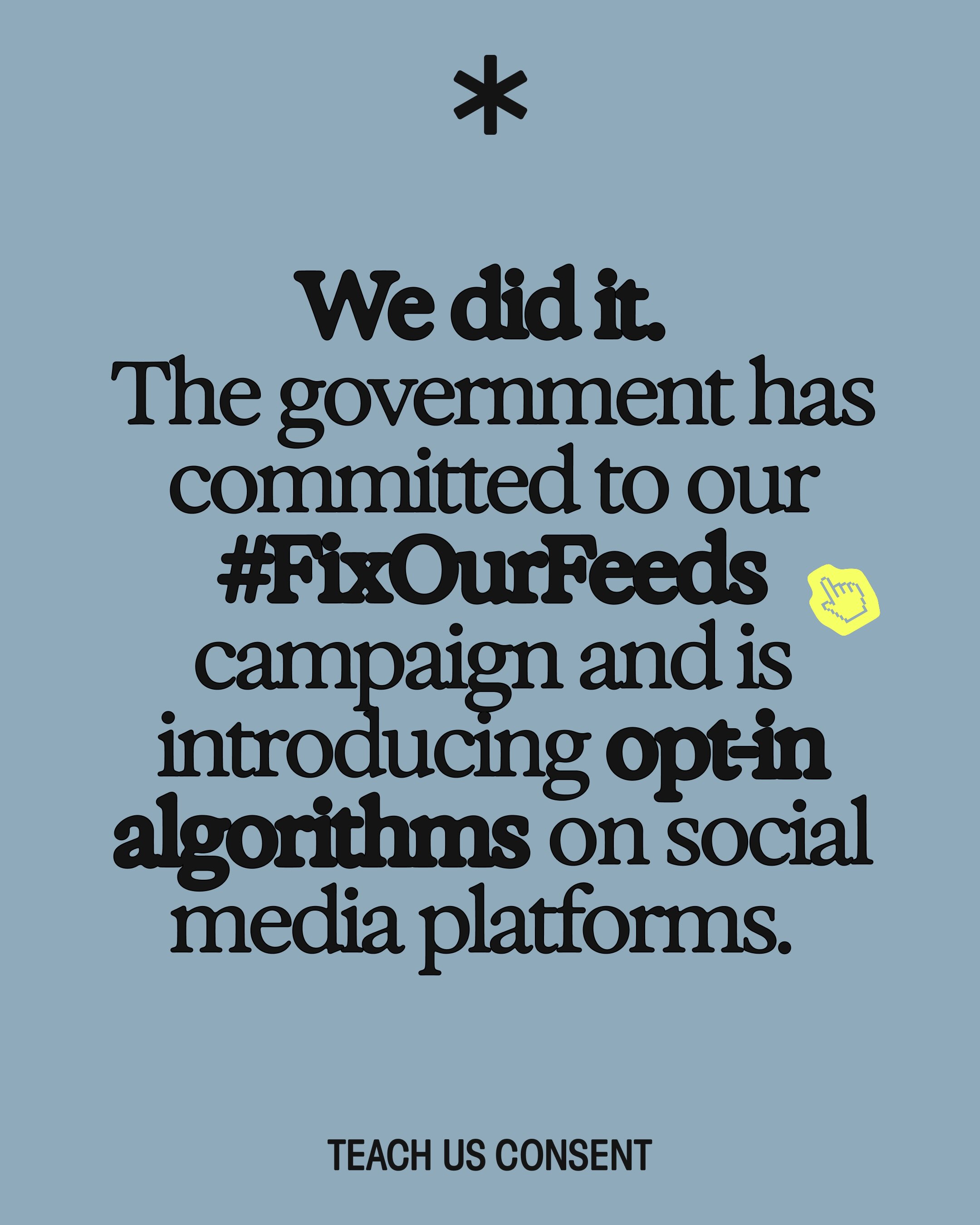
We did it.

On September 8 the Albanese Government committed to bringing Australians choice about whether they have recommendation algorithms on social media platforms. This is a major step towards addressing the power imbalance between Big Tech and everyday Australians, and it reminds us that we don’t have to accept invasive, addictive design as the cost of being online. Now, we're consulting with the government to ensure the legislation is air-tight and matches the ambition.

This is one piece of a much bigger picture. Ending gender-based violence requires a broad and interconnected range of solutions, and we'll keep pushing for the reforms needed. For now: thank you.
Misogynistic content is rife
73% of Gen Z social-media users have seen misogynistic content online, with 70% saying they believe misogynistic language and content are increasing. This rises to 80% for women.
73%
73%
Brits want change
Recent polling from Teach Us Consent finds that xx% of Brits think social media users should have full control over what they see online.
##%
##%
Sexual violence is increasing
In the UK, child perpetrated sexual offenses rose by 47% in 2023-24 and continue to rise.
47% increase
47% increase
Sexual violence is increasing
In 2025, there was a 27% rise in referrals to the UK Government's counter radicalisation programme, with online factors cited as an influencing factor.
27% rise
27% rise
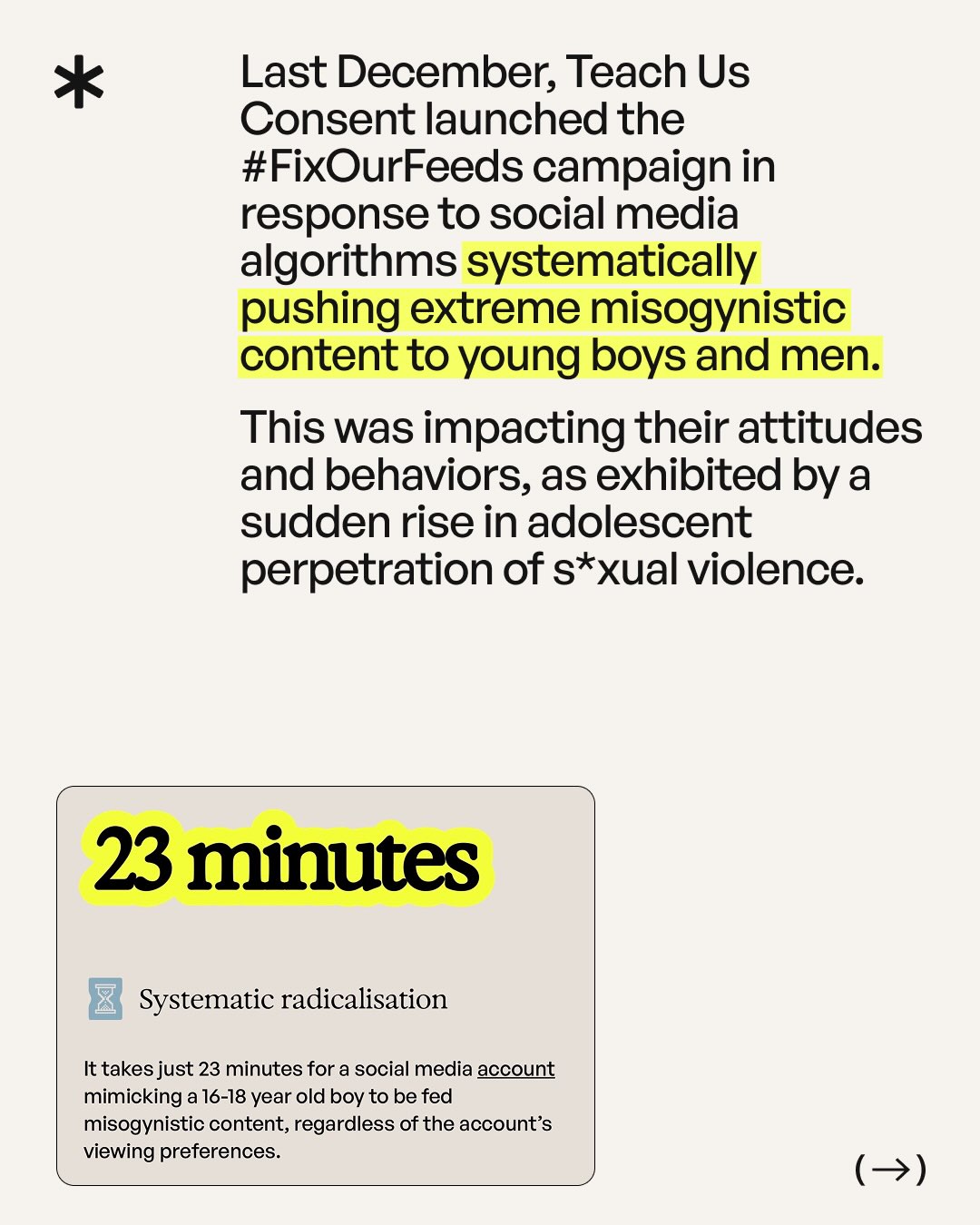
Systematic radicalisation
It takes just 23 minutes for a social media account mimicking a 16-18 year old boy to be fed misogynistic content, regardless of the account’s viewing preferences.
23 minutes
23 minutes

Sign the petition for opt-in algorithms in the UK

7
PETITION Signatures
Our Goal: 1,000
ENDORSED BY
Dr Zac Seidler, Global Director of Movember
Jess Hill, Industry Professor at the University of Technology Sydney
Daniel Principe, Youth Advocate and Educator
Dr Zac Seidler, Global Director of Movember
Jess Hill, Industry Professor at the University of Technology Sydney
Daniel Principe, Youth Advocate and Educator
Dr Joanne Gray, University of Sydney
Ben Vasiliou, CEO of The Man Cave
Professor Michael Flood, Queensland University of Technology
Dr Joanne Gray, University of Sydney
Ben Vasiliou, CEO of The Man Cave
Professor Michael Flood, Queensland University of Technology
Jim Hungerford, CEO of the Butterfly Foundation
Dr Joy Townsend, CEO of Learning Consent
Benjamin Law, Writer and Broadcaster
Jim Hungerford, CEO of the Butterfly Foundation
Dr Joy Townsend, CEO of Learning Consent
Benjamin Law, Writer and Broadcaster
Professor Ben Mathews, Queensland University of Technology 
Nicole Yade, CEO of Women’s and Girls’ Emergency Centre
Zahra Al Hilaly, UN Women’s Generation Equality Youth Task Force
Professor Ben Mathews, Queensland University of Technology 
Nicole Yade, CEO of Women’s and Girls’ Emergency Centre
Zahra Al Hilaly, UN Women’s Generation Equality Youth Task Force
Blake Pavey, Comedian and Content Creator
Zoë Foster Blake, Author and Entrepreneur
Gina Martin, Gender Equality Activist
Blake Pavey, Comedian and Content Creator
Zoë Foster Blake, Author and Entrepreneur
Gina Martin, Gender Equality Activist
Charlotte Mortlock, Executive Director Hilma's Network
Yvonne Weldon AM, NSW Aboriginal Woman of the Year (2022)
Susanne Legena, CEO Plan International Australia
Charlotte Mortlock, Executive Director Hilma's Network
Yvonne Weldon AM, NSW Aboriginal Woman of the Year (2022)
Susanne Legena, CEO Plan International Australia
Maree Crabbe, Director at It’s Time We Talked
Melissa Abu-Gazaleh, Founder and Managing Director of Top Blokes
Michelle Ryan, Director of Global Institute for Women's Leadership
Maree Crabbe, Director at It’s Time We Talked
Melissa Abu-Gazaleh, Founder and Managing Director of Top Blokes
Michelle Ryan, Director of Global Institute for Women's Leadership
Wendy McCarthy AC, Businesswoman, Activist and Author
Jack Toohey, Author and Activist
Meredith Turnbull, Principal at VOX FEMINA
Wendy McCarthy AC, Businesswoman, Activist and Author
Jack Toohey, Author and Activist
Meredith Turnbull, Principal at VOX FEMINA

Why we’re calling for

#FixOurFeeds
#FixOurFeeds
Algorithms are designed to maximise engagement, not wellbeing.
By prioritising content that provokes outrage, fear, validation and anger, these systems can rapidly steer young people towards increasingly extreme content. For young men and boys, that often means misogynistic influencers and online communities that normalise hostility towards women. Research has repeatedly shown that accounts designed to mimic teenage boys can begin receiving this content within minutes, even without actively searching for it.
The consequences reach far beyond our screens.
Exposure to misogynistic content is linked to attitudes that excuse violence against women and girls, undermine gender equality and increase support for harmful stereotypes. In the UK, child-perpetrated sexual offences rose by 47% between 2023 and 2024. Men and boys are harmed by the algorithm-driven recommendation economy too. Many boys are looking for connection and guidance, only to be served increasingly extreme content that fuels loneliness, division and unhealthy ideas about masculinity.
It’s a growing national security issue.
The United Kingdom knows first-hand how foreign states can exploit social media algorithms to sow division and interfere with democracy. Research also shows that misogyny is one of the most consistent pathways into violent extremism. As misogynistic violent extremism continues to rise, young people are increasingly becoming both the targets of radicalisation and, in some cases, its perpetrators. Recommendation algorithms are acting as accelerants, and they must be addressed.
A better approach is possible.
Following advocacy from Teach Us Consent’s #FixOurFeeds campaign, the Australian Government committed to world-first action this year. Tech platforms must now give Australians the choice to opt in to recommendation algorithms and turn off recommended content in their social media feeds. It’s clear: we do not have to accept invasive, addictive platform design as the cost of being online.
We’re calling on the UK government to require social media companies to offer users the option to opt in to recommendation algorithms, rather than enrolling everyone automatically.
The simple, content-neutral reform would give people greater control over what appears in their feeds through informed and affirmative consent.

It would help reduce the likelihood of young men and boys being funnelled into extremist and misogynistic online spaces, while also benefiting people vulnerable to eating disorders, self-harm, sexually explicit content and other harmful recommendation pathways. It would also give anyone wanting to spend less time on social media a genuine alternative to addictive, algorithmically curated feeds.

Ultimately, this is about restoring control to the people who use these platforms. The technology already exists. Now it's time for the UK Government to require social media companies to give people a real choice over what appears on their screens.

We asked our followers:

“Do you know someone who has been radicalised by the algorithm?”
63% said yes
63% said yes

"My son-in-law believed reptilians were running the government"

"My brother now believes that immigrants are the main perpetrators of sexual assault"

"Men in my life have had their opinion of women significantly changed via Instagram"

"My brothers started quoting sexist and derogatory male influencers from social media"

"Ex-boyfriend told me I was a hypocrite and crazy for taking the pill for endometriosis"

"He said there’s no such thing as rape in child marriages"

"A friendship broke down because they became completely anti-science"

Got questions? We’ve got answers.

(Q)

How would opt-in algorithms actually work?

Click to flip

(A)

Social media platforms would be required to send users a clear prompt asking them to choose their feed type. Choosing a following-only feed means seeing only content from people and topics you've intentionally chosen to follow, not a feed an algorithm has built for you. Choosing an algorithm-driven feed keeps things as they currently are. You'd be able to change your choice at any time, and you can make different choices across platforms.

(Q)

Can’t you already opt-out of personalised feeds on some social media apps?

Click to flip

(A)

Currently, some apps allow you to customise your feeds in different ways. Some give you the option to turn off personalised feeds. However, they don’t go all the way: personalised feeds still remain the default on social media, feeds often easily revert back to personalisation if you leave the app, and ultimately, there’s no legislation that requires platforms to have an opt-in option, so most don’t offer this option as the default.

(Q)

What will the Instagram Explore Page /TikTok’s For You Page look like if I turn it off?

Click to flip

(A)

In the European Union, where similar policies are in place, the Explore pages show content as usual. But instead of the content being personalised to you, it would show generally popular videos at the time.

(Q)

My feed isn’t misogynistic. Does that mean it’s not harmful?

Click to flip

(A)

Unfortunately, there are many forms of harmful content circulated by social media algorithms. For instance, your feed may not be misogynistic, but you still may want to turn off your algorithm on socials to prevent exposure to eating disorder or self harm content, mis/disinformation, other forms of hateful content, or just to give yourself a break from the doom-scroll. If you're someone who loves your feed, then it can simply be a helpful option to spend less time on your phone, if you want to use it.

(Q)

What if I don’t want to turn my algorithm off?

Click to flip

(A)

You can still support this policy but opt-in for an algorithmically-driven social media feed. Our intent is to give all Brits the option.

(Q)

Is this about censoring the internet?

Click to flip

(A)

No. Censorship is an authority body deciding what may be said or not said. What the proposed reforms will do is the opposite, allowing an individual to decide what they want to see. Our feeds are currently shaped by opaque algorithmically driven ranking systems that we didn’t design, can’t inspect and have almost no control over. Social media recommendation algorithms already promote and bury content with no transparency. Handing that choice to the person using the platform is giving people agency over their own feed, not censorship.

(Q)

Is this the same as the EU's system?

Click to flip

(A)

Not quite. The EU intruduced a mandatory opt-out for social media algorithms, but the wording of the legislation wasn't air-tight, leaving room for platforms to comply on paper while defeating it in practice. For example - resetting the feed back to algorithmic every time someone closed and reopened the app. We're pushing for the UK's approach to be genuinely opt-in, and for the legislation to be tight enough that platforms can't repeat that same workaround.

(Q)

What has happened in Australia?

Click to flip

(A)

Following Teach Us Consent's Fix Our Feeds campaign, the Australian Government committed to introducing opt-in algorithms as part of its Digital Duty of Care legislation. Under its "My Feed, My Way" model, users will be prompted to choose between a following-only feed and an algorithm-driven feed when they sign up, and existing users will be given the same choice. The legislation passed Parliament on 25 November 2026. Australia has shown it can be done. Now we want the UK to follow.

(Q)

Why the UK, and why now?

Click to flip

(A)

Online safety laws have just been strengthened in Australia and are being considered in Canada and the UK. As middle powers, these countries have more leverage with Big Tech acting together than alone. The UK has already led the world with its Online Safety Act, which requires platforms to tackle illegal content and protect children from harmful content. But it doesn't give people in the UK a simple, legal right to choose whether an algorithm shapes their feed. Opt-in algorithms would build on the Act by putting that choice in users' hands.

(Q)

Who are Teach Us Consent?

Click to flip

(A)

Teach Us Consent is a youth-led charity working toward a world free of normalised sexual violence. Founded by advocate Chanel Contos in 2021, our organisation was responsible for mandatory consent and respectful relationships education being introduced into the Australian national curriculum, and now continues work to drive systemic and cultural change through digital education, policy advocacy and partnerships in culturally significant spaces.

#fixourfeeds

The scroll ends here. You’ve consumed all the information you need to know.

Sign the Petition